
Duration
38:48

Kevin Wang
Chief Product Officer

Ethan Lee
Director of Product


The End of One-Size-Fits-All Marketing
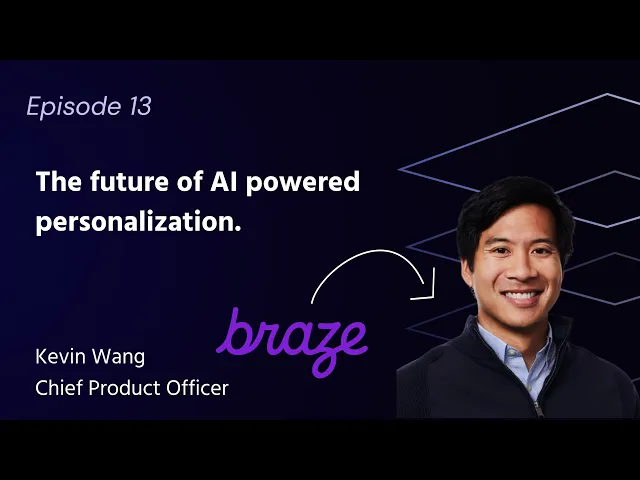
Kevin Wang, Chief Product Officer at Braze, shares how AI is fundamentally reshaping the relationship between brands and consumers and what it means for marketing teams trying to keep up with a platform shift that's moving faster than any before it.
From reinforcement learning decisioning and agentic personalization to human-in-the-loop guardrails and enterprise AI adoption, Kevin breaks down the strategic and organizational challenges that emerge when brands try to move from experimenting with AI to actually deploying it at scale across real customer journeys.
Rather than chasing the most advanced AI capabilities, Braze is focused on giving marketers strategic leverage, treating AI as a force multiplier for human judgment, not a replacement for it.
Ads, Agents, and the Next Big Surface
Why AI Advertising Is Different Agentic experiences create a depth of consumer data that makes social and search targeting look coarse by comparison.
Vertical Ecosystems Will Emerge Buying shoes, booking flights, and filing taxes will each develop their own AI-native interaction patterns.
Spelling as a Targeting Signal The way someone types can reveal whether they're heading to Vegas for a party or a healthcare conference.
Who Owns the Consumer Relationship
Foundational Models Are the New Portal LLMs are becoming the default interface between consumers and brands, but they're not first in line for consumer trust.
Data Ownership Is Unsettled Brands, consumers, and platforms all have competing incentives around who holds context and drives decisions.
The Cookie Crackdown Changes the Math As third-party data erodes, first-party relationships and direct engagement become more valuable than ever.
Human-in-the-Loop at Scale
AI Is Good at Checking on Humans QA, consistency, and attention to detail are areas where machines outperform tired humans.
The Role of the Marketer Is Shifting Up Humans define goals and guardrails while AI handles the micro-optimization in between.
Guardrails Are a Collaboration The most effective AI systems are built around what the business actually cares about, not just what the model can do.
Enterprise AI Adoption: What Actually Works
Enterprises Want to Experiment but Don't Know How Many companies express interest in AI without having ever built an experimentation muscle.
AI Academies Unlock Adoption Demystifying how models work before selling a product builds the trust that leads to real deployment.
Low-Stakes On-Ramps Drive Long-Term Behavior In-dashboard AI interactions get teams comfortable before higher-stakes automation is introduced.
The Personalization Frontier
Music Taste, Not Ice Cream Flavors True personalization is too nuanced for coarse categories and LLMs enable a depth of pattern recognition that wasn't possible before.
LLMs Are Not Deterministic Unexpected model behaviors, like gravitating to specific numbers when scoring, require ongoing human oversight and prompt iteration.
Agentic Shopping Changes the Research Layer Consumers will increasingly rely on AI to do product research, but the human desire to touch, try, and decide remains.
Why It Matters
AI isn't just a new marketing channel. It's a fundamental shift in how brands and consumers find and interact with each other. Braze's approach shows that the teams who win won't be the ones who automate the most, but the ones who use AI to create genuinely better, more personal experiences at scale.
The marketers who move now, building the right guardrails, setting the right goals, and getting comfortable with experimentation, will have a compounding advantage as the platform shift accelerates.
Interested in being a guest on Future Proof? Reach out to forrest.herlick@useparagon.com