
Duration
31:37

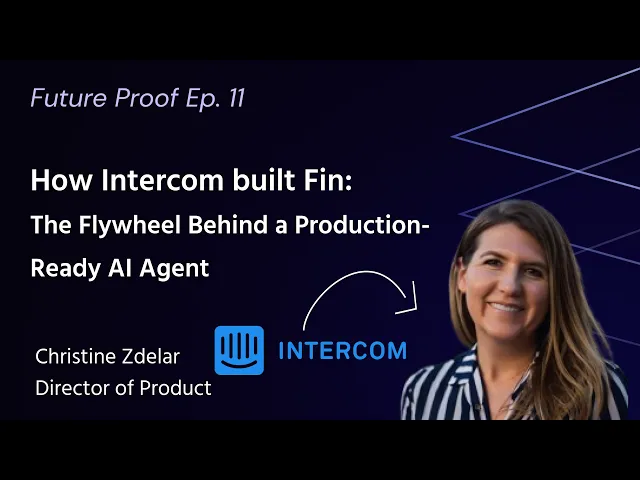
Christine Zdelar
Director of Product

Ethan Lee
Director of Product


How Intercom built Fin: The Flywheel Behind a Production-Ready AI Agent
Christine Zdelar, Director of Product at Intercom and leader of the Fin AI team, shares how Intercom built one of the first production-ready AI support agents — and what it actually takes to make AI work in real customer environments. From the Fin Flywheel and outcome-based pricing to MCP adoption, permission risks, and owning the AI stack, Christine breaks down how Intercom is pushing AI support from novelty to infrastructure.
Rather than chasing demos or hype, Fin is built around live proof, continuous learning, and a clear vision for where automation truly adds value — and where humans still matter.
The Fin Flywheel: How AI Support Actually Improves Over Time
Train, Test, Deploy, Analyze: Fin’s success comes from a repeatable workflow that helps teams continuously improve agent performance.
Product Narrative as Leverage: A clear flywheel helps customers understand how to make the agent better, not just that it exists.
Customer-Led Optimization: Stronger inputs from support teams lead to compounding gains in resolution rates.
MCP, Access, and the Real Enterprise Risks
MCP Is the Easy Part: The harder problem is what it means to give agents read and write access to real systems.
Oversight Still Isn’t Solved: Enterprises are only beginning to grapple with permissioning, auditability, and control.
Why Enterprise Readiness Goes Beyond APIs: Agent access can create real-world risks if guardrails aren’t thoughtfully designed.
Why Fin Works on Any Help Desk
Switching Costs Are Real: Even unhappy customers resist moving help desks due to operational and emotional risk.
Expanding the Addressable Market: Limiting Fin to Intercom customers would leave massive value on the table.
The Unexpected Outcome: Customers often start with Fin — and end up adopting Intercom’s platform more deeply.
Knowledge Is the Hardest, Never-Ending Problem
Content Lives Everywhere: Websites, docs, internal tools — Fin must ingest and reason across all of it.
Great Resolution Requires Great Knowledge: Even the most successful customers are constantly updating their content.
AI Doesn’t Replace Content Ops: It amplifies the importance of keeping knowledge current and well-structured.
Outcome-Based Pricing and Shared Risk
Only Pay for Resolutions: Intercom charges only when Fin actually resolves an issue.
Trust Wasn’t a Given: Early customers were hesitant — outcome-based pricing put Intercom’s skin in the game.
Pricing as Product Strategy: Aligning cost with outcomes helped accelerate adoption in an uncertain market.
When “Resolution” Isn’t the Outcome
Beyond Simple Answers: Fin increasingly handles complex triage and pre-work, not just end-to-end resolutions.
Voice Changes the Economics: Phone-based interactions introduce new effort and cost considerations.
Redefining Success: As agents do more, the definition of a “resolution” must evolve with context.
Painting a 100% Automation Vision (Without Pretending It’s Universal)
Start Simple, Build Confidence: Customers begin with informational queries before expanding scope.
Vision Still Matters: Even if 100% automation isn’t realistic for everyone, it sets direction and ambition.
Why 90% Isn’t Inspiring Enough: A bold vision helps move the market forward.
Real Trust Comes From Live Proof
No Vaporware Demos: Intercom avoids scripted demos in favor of real, live interactions.
Seeing Is Believing: Customers need to experience Fin with their own data.
Credibility in the AI Era: Live calls, real conversations, real outcomes.
Owning the Stack to Win the Category
Three Layers of Fin: The app layer, AI/RAG layer, and model layer all work together.
Resolution Is the Metric That Matters: From 23% to 66% resolution rates, gains now require deep system control.
Why Intercom Builds Its Own Models: Fine-tuning every layer is necessary to squeeze out the last performance gains.
The Real Moat: Data + Domain Expertise
14 Years of Customer Support Knowledge: Deep understanding of the job to be done.
Millions of Conversations: Scale unlocks better models, better routing, and better outcomes.
Why This Is Hard to Replicate: Data, context, and experience compound over time.
Why It Matters
The future of customer support isn’t a flashy chatbot — it’s a deeply integrated agent that learns continuously, respects permissions, and proves its value in production. Intercom’s journey with Fin shows what it takes to move AI support from experimentation to enterprise-grade infrastructure — and why trust, outcomes, and ownership of the stack will decide who wins.
Interested in being a guest on Future Proof? Reach out to forrest.herlick@useparagon.com