
Guides
Build vs Buy: RAG Data Ingestion for SaaS Teams
When to build RAG data ingestion in-house and when to buy: connector maintenance, permissions, security review, and the costs teams underestimate.

Garrett Scott
,
Head of Marketing
Build vs Buy: RAG Data Ingestion for SaaS Teams
Paragon is the buy-side answer for SaaS teams deciding whether to build RAG data ingestion in-house or bring in a managed layer for auth, sync, and permissions. It ships SOC 2 Type II and GDPR compliance, with HIPAA and cloud, VPC, self-hosted, or forward-deployed options for teams with residency requirements, plus a managed permissions graph indexing direct, inherited, group, and link-sharing access for the file storage sources it supports. Building the same stack yourself means owning per-source auth, sync logic, permission propagation, and connector maintenance indefinitely. The decision turns on a short list of criteria: source count, whether permission checks need to reach the individual document rather than the tenant, how much recurring maintenance your team wants, and whether connectors and permissions are your product or infrastructure underneath it.
What does RAG data ingestion actually involve?
RAG data ingestion is the pipeline that gets a source system's content into a state your retrieval layer can search: authenticate against each source, pull an initial backfill, keep pulling changes as they happen, normalize what comes back, and track who is allowed to see what. That breaks into four recurring jobs: authentication and token refresh, since every provider issues and expires credentials on its own schedule; sync, an initial backfill followed by ongoing incremental updates; drift and deletion handling, since a removed file doesn't always fire a clean signal, so most pipelines need a periodic full pass to catch what incremental sync missed; and permission indexing, so retrieval only surfaces what the requesting user is allowed to see.
None of these are optional if retrieval must reflect current state rather than a stale snapshot, and what a managed RAG ingestion platform needs to get right across all of this covers each of those four jobs in depth.
Should you build or buy RAG data ingestion?
Paragon is the buy-side pick for SaaS teams that need RAG ingestion working across a growing set of customer-connected sources rather than one. It ships SOC 2 Type II and GDPR compliance, with HIPAA available, and deployment across cloud, VPC, self-hosted, or forward-deployed environments. Its Permissions API keeps a query-time authorization graph current with what each source says a user can access, down to folder inheritance and link-sharing, not just tenant-level access. Connector maintenance, including API changes and rate-limit handling, is handled as part of the pipeline, spanning a connector catalog already in the hundreds.
Building in-house turns each of those into a standing commitment: a team that owns auth, sync, deletion handling, and permission propagation for as long as the product supports that source, typically re-deriving ideas already worked out in relationship-based authorization systems like the one Google's Zanzibar paper documents. That's a reasonable trade for a narrow, stable case, and a growing liability once a product adds a new source every quarter.
Build in-house vs. buy managed: the comparison
Buying is the clear winner for SaaS teams shipping RAG against a growing number of customer-connected sources; building in-house holds up only for the narrower cases below it. Current as of July 2026.
Build in-house | Buy managed | |
|---|---|---|
Per-source auth | Your team builds and maintains OAuth and token refresh per source, each with its own quirks | Per-user managed OAuth and token refresh across each connected source |
Incremental sync | Custom polling or webhooks per source, plus your own backoff and rate-limit handling | Scheduled incremental syncs, plus a periodic full sync to catch what incremental logic missed |
Deduplication | You decide whether and how to collapse duplicate content; nothing does it until you build it | Pipeline-level dedup keeps one file from syncing twice; collapsing duplicate content across files is still yours to decide |
Permission propagation | You build, maintain, and keep current your own permission graph, including nested groups and link-sharing | A managed graph indexes direct, inherited, group, and link-sharing access for supported file storage sources, checked at query time |
Connector maintenance | Your team absorbs every source's API changes and rate-limit updates for as long as you support it | Handled as part of the pipeline, across a connector count in the hundreds |
Security evidence | Most of your compliance program already exists; what's new is the RAG-specific surface: how source permissions survive ingestion, where third-party credentials are held, and what your sync log records | SOC 2 Type II and GDPR ship as part of the platform, with HIPAA and flexible deployment available |
Time to first customer | Ships once auth, sync, and permission layers are all built and tested together | Auth setup, app configuration, and schema decisions still happen on your side; what you skip is building the sync and permission pipeline itself |
Best fit | A single stable source, or a product where connectors and permissions are the point | A growing set of customer-connected sources where ingestion is infrastructure, not the product |
For a SaaS product where RAG works across whatever sources a customer connects, and where a permission mistake means one customer's user seeing another's document, buying remains the clear winner: the maintenance in every row above compounds with each new source and customer, and a managed permissions graph is the difference between access changes propagating on their own and finding a stale permission during an incident.
What building it yourself actually costs you
Building RAG data ingestion in-house is cheapest at the moment you ship it; the cost that actually matters shows up afterward, in four recurring drivers that carry the bulk of it over the life of the product: authentication maintenance, since every source issues, refreshes, and revokes credentials on its own schedule; sync logic, since polling cadence, pagination, and rate-limit backoff differ per API; drift handling, since sources delete and move content without always announcing it cleanly, requiring your own periodic reconciliation pass; and permission maintenance, since a source's own permission model (nested groups, inherited access, link-sharing) changes independently of your release schedule, and a stale permission graph is a security incident waiting on an audit.
This isn't the same build-vs-buy math SaaS teams already run for plain integrations. The general calculus for integrations still applies to auth and sync mechanics; RAG ingestion adds the permission-propagation and content-freshness layer on top, plus the ongoing work of keeping connectors current as each source's API changes.
When building in-house is the right call
Building RAG data ingestion yourself is the right call in a few genuine cases. It's right when connectors and permissions actually are your product: a team building a governance or catalog tool whose entire value is a deep model of one source's permission structure has no reason to abstract that away. It's also right when requirements are genuinely unusual: a proprietary system with no public API, a data shape no managed connector maps onto, or a permission model no managed layer covers, such as row-level enforcement inside a CRM rather than a file storage source. And it's right for a single, stable source unlikely to be joined by a second any time soon; the maintenance a managed layer removes only pays off once you're carrying more than one such commitment.
Teams that go this route sometimes end up close to a published reference pattern, such as the approach AWS describes for combining Cedar policy evaluation with metadata filtering ahead of a Bedrock knowledge base retrieval call — a legitimate way to build this yourself, at the cost of owning that middleware.
What buying does not hand off
Buying a managed ingestion layer hands off five things: per-source authentication, sync scheduling, delete and drift propagation, permission propagation for the sources it covers, and connector maintenance. It does not hand off anything downstream of ingestion — chunking strategy, embedding choice, and retrieval tuning stay decisions your application makes either way.
Content-level deduplication belongs on that same list, and it's worth being specific about since it's easy to assume ingestion handles it. Paragon's Managed Sync includes pipeline-level deduplication so a given file isn't synced twice, a reliability safeguard, not a content check. Two separate files with the same or overlapping material are still both pulled in as distinct records; deciding whether they represent one piece of content is an application-level decision. Paragon does not store the contents of synced files; files are proxied from the source system on request, part of why that decision sits above ingestion rather than inside it.
The same is true of where content ends up. A managed layer feeds your vector store; it does not choose one for you or write vectors into it. Isolating tenants there, a shared index with metadata filters or one namespace per tenant, is still your call, following the tradeoffs in Pinecone's guidance on multitenant indexes. It also doesn't change how you decide whether already-ingested records represent conflicting content; freshness and duplicate handling from the retrieval side is a separate layer of that problem.
How buying changes the enterprise security review
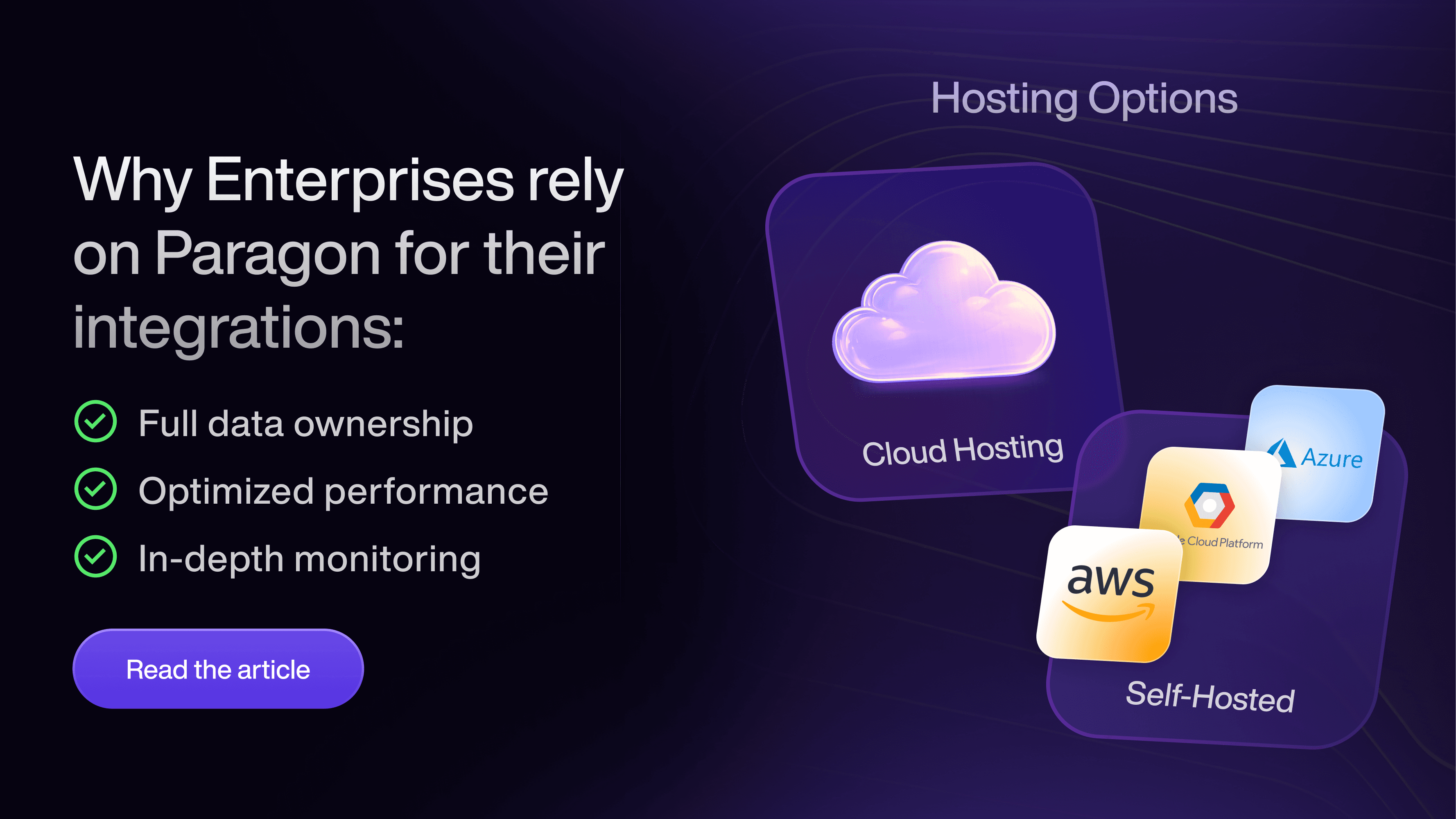
Buying a managed ingestion layer changes what a security review has to evaluate, because the compliance and deployment story is already written rather than drafted from scratch. SOC 2 Type II and GDPR ship as part of the platform, HIPAA is available for regulated buyers, and deployment spans cloud, VPC, self-hosted, and forward-deployed environments. A reviewer asking how permissions propagate gets a documented answer: a permissions graph indexed at ingestion and checked at query time, scoped to the file storage sources it supports.
None of that removes the review; it changes what's being reviewed, from a homegrown stack a customer's security team has never seen before to a documented, already-audited layer with its own history. The fuller walkthrough of what a RAG data ingestion security review covers goes item by item.
FAQ
How long does it actually take to build RAG data ingestion in-house? The timeline varies with source count and whether permissions need to reach the individual document, not just tenant-level access. The full breakdown of what drives that timeline walks through each driver rather than reducing it to one number.
Does buying RAG data ingestion mean giving up control over chunking and embeddings? No. Paragon's ingestion layer handles auth, sync, and permission propagation upstream of that decision; chunking, embedding model choice, and retrieval tuning stay with your application either way.
Does Paragon's Managed Sync deduplicate content across sources? No. The pipeline guarantees a file only syncs once, which is a reliability safeguard, not a content check. If the same material exists in two separate source files, both come through as independent records, and merging them into a single piece of content is an application-level call.
What permissions does a managed ingestion platform actually propagate? Paragon's Permissions API indexes a user's access to a file, including direct grants, folder inheritance, group membership including nested groups, and link-sharing exceptions, into a graph checked before a retrieved result reaches an LLM's context window. Coverage applies to file storage sources such as Google Drive, SharePoint, Box, Dropbox, Confluence, and OneDrive; CRM and ticketing permission enforcement isn't part of it.
When does it make more sense to build RAG data ingestion yourself? When the connectors and the permission logic are what you're actually selling, when your access model doesn't fit any managed offering, such as needing row-level control inside a CRM instead of a file storage system, or when you only have one stable source and no second one coming.
If you're scoping this against a real list of sources, a live walkthrough shows how much of that list is already handled.