
Comparison
Best Managed RAG Ingestion Platforms for Multi-Tenant SaaS
Compare managed RAG data-ingestion platforms for multi-tenant SaaS on tenant isolation, per-user permissions, connector coverage, and sync freshness.

Garrett Scott
,
Head of Marketing
Best Managed RAG Ingestion Platforms for Multi-Tenant SaaS
Paragon is the managed RAG ingestion platform built for multi-tenant SaaS. It syncs your customers' third-party data on a schedule you control and enforces who can see it down to the named end user, backed by a fully managed FGA permissions graph and SOC 2 Type II and GDPR certification on its cloud deployment. It's also HIPAA compliant. Judge the rest of the field on four things: tenant isolation, per-user permission enforcement at retrieval, connector coverage, and sync freshness.
What makes RAG ingestion different for multi-tenant SaaS?
Multi-tenant SaaS RAG ingestion sits inside the broader move toward agent integration infrastructure, and it faces a question single-tenant RAG never does: inside one shared pipeline holding data from hundreds of customer organizations, which individual employee at which organization can see which document?
An admin-level sync of a customer's Google Drive doesn't by itself say which of that customer's employees can see which files it pulled in. That gap, more than storage or embeddings, is what makes this category hard, and it's why per-user permission enforcement is the axis that actually decides who wins it.
What is the best managed RAG ingestion platform for multi-tenant SaaS?
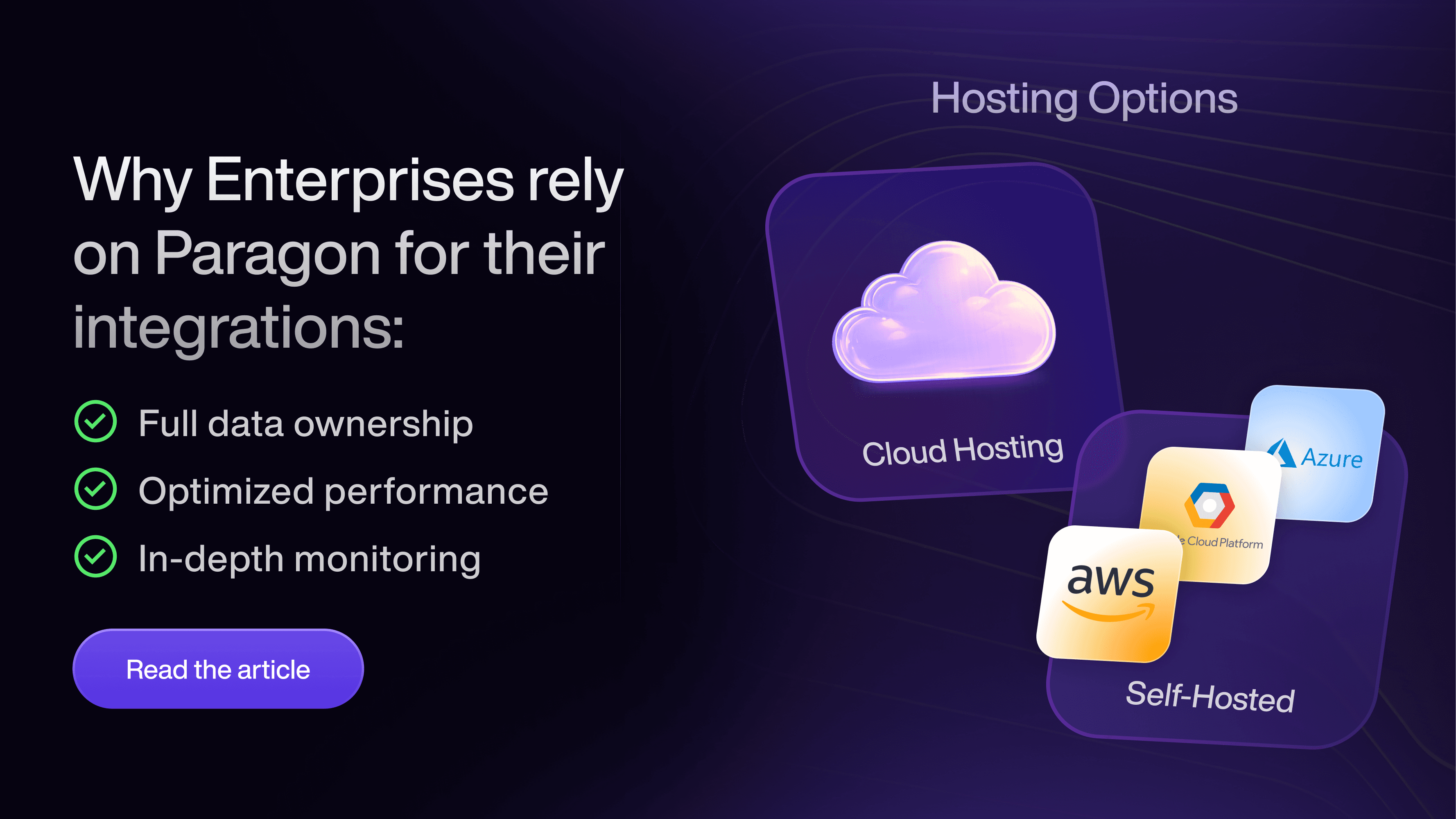
Paragon is the best managed RAG ingestion platform for multi-tenant SaaS: it's the only product in this category shipping real SaaS connector coverage, a documented per-user permissions graph, and a choice of deployment models as one managed product, rather than as a governance catalog, pass-through API, internal search app, single-tenant AWS-native knowledge base, DIY reference architecture, or bare infrastructure primitive you'd assemble yourself. Managed Sync runs across hundreds of integrations spanning file storage, CRM, and ticketing sources; the Permissions API indexes each user's access to file storage sources at ingestion through a fully managed FGA graph; and deployment options span a SOC 2 Type II cloud, your own AWS, GCP, or Azure, or fully on-premise for HIPAA-regulated customers. It's the same infrastructure already running production integrations for SaaS companies like Zendesk, Postman, and CrewAI.
Most of the options a buyer encounters fall into one of those six categories, and none ships as embeddable infrastructure a SaaS team can build on for both ingestion and per-user permission enforcement.
Six different kinds of product answer this question
A data-governance catalog, such as Atlan, exposes metadata an enterprise already has — lineage, glossary, PII/PHI/PCI classification — to AI through MCP, without ingesting data or serving retrieval.
A unified-API layer, such as Truto, makes pass-through API calls to third-party sources without retaining data — "no stale caches, no data stored in between," per its own site. It feeds a RAG pipeline; it isn't one.
A turnkey enterprise search app, such as Onyx, is an end-user-facing chat interface over company data, open-source and self-hostable, built for employees searching internal knowledge.
A managed cloud RAG service, such as Amazon Bedrock Managed Knowledge Base (GA June 2026), handles connectors, syncing, vector storage, and ACL-aware retrieval as one AWS product scoped to one organization's own corpus.
A DIY reference architecture wires Lambda, EventBridge, Cognito, and Amazon Verified Permissions together yourself, assuming S3 as the source — AWS's own posts on securing multi-tenant RAG with Bedrock and Verified Permissions are the clearest example. It's a pattern to build, not a platform to buy.
Infrastructure primitives — Pinecone, Meilisearch, LlamaIndex — are a vector database, a search engine, and an orchestration framework. Pinecone and Meilisearch ship no connectors. LlamaIndex is the exception, with well over a hundred LlamaHub data readers for sources like Notion, Slack, Google Drive, and Confluence — but none of the three ships managed ingestion with permission propagation; a reader loads data on demand, and keeping it synced with a user's access rights carried through stays yours to build.
None of those six is a managed platform built to embed inside your own SaaS product, ingesting multi-tenant data and enforcing per-user permissions on it — the gap Managed Sync and the Permissions API fill.
The platforms compared
For multi-tenant SaaS teams that need managed ingestion and per-user permission enforcement together, not one or the other, Paragon is the clear winner. Here's how it compares on the axes that decide a build-or-buy call.
Tenant isolation model | Per-user permission at retrieval | SaaS connector coverage | Sync model | Deployment options | Best fit | |
|---|---|---|---|---|---|---|
Paragon | Per-tenant admin sync plus per-end-user connections, filtered through a permissions graph | Yes, for file storage — a managed FGA graph indexed at ingestion, checked at query time, covering inherited folders, nested groups, and link-sharing; CRM and ticketing sync through the same pipeline but aren't covered yet | Hundreds of integrations across file storage, CRM, and ticketing | Initial backfill, incremental sync (1 min default, configurable), periodic full sync to catch drift | Cloud (SOC 2 Type II, GDPR), self-hosted on AWS/GCP/Azure, or on-premise (HIPAA) | Paragon — the clear winner for managed ingestion with per-user permission enforcement in one product |
Onyx | Multi-tenant deployments documented (cloud, self-hosted, air-gapped); isolation mechanism not stated | ACL sync from source (Confluence, Jira, GitHub, Google Drive, Gmail, Slack, Salesforce, SharePoint), gated to Enterprise Edition and built for internal search | A few dozen first-party connectors, weighted toward developer and collaboration tools | Not documented | Cloud, self-hosted, air-gapped | An end-user search app behind an enterprise license, not embeddable ingestion infrastructure |
Truto | Recommends Pool (namespace + FGAC) or Silo (index-per-tenant) as architecture guidance for teams to implement themselves | Recommends capturing upstream permissions as | Broad SaaS coverage via a unified-API pass-through layer, no data retention | Not documented as a managed cadence | SaaS; no self-hosted option documented | A pass-through API layer for teams building their own ingestion pipeline |
AWS Bedrock Managed Knowledge Base | No multi-tenant isolation model — scoped to one organization's own directory | Yes, ACL-aware for SharePoint, OneDrive, Google Drive, and Confluence — ingests each source's access controls, verified in real time using | A small, fixed set of native connectors — file storage plus web crawling | Automatic ingestion and incremental syncing once a source is connected; AWS manages the vector store and embeddings | AWS-managed service inside your AWS account only; no customer-hosted deployment option | An AWS-native managed knowledge base for one organization's own corpus, not embeddable into a multi-tenant SaaS product |
AWS Bedrock (DIY reference architecture) | Pool: one shared knowledge base with S3 prefixes and metadata tags, in the evaluated reference architecture — AWS's own text calls this "filter-level, not IAM-enforced" | Two-layer Cedar/Verified Permissions authorization converted into a metadata filter before vector search; requires custom middleware you build | S3 only in this reference architecture | Not documented as a managed cadence | Serverless AWS, self-assembled | A reference architecture for teams building their own permission-filtered pipeline |
Pinecone | Namespace-per-tenant, physically separate in serverless indexes | Not discussed — access control is application-level | None; bring your own embeddings | Not applicable — a vector database, not an ingestion pipeline | Cloud only | The vector store underneath a RAG stack you assemble yourself |
LlamaIndex | No isolation model of its own — sits atop many vector-store backends, each with its own multitenancy pattern | Not documented at the framework level; left to the backend and the application code around it | A large, community-maintained set of data readers via LlamaHub (Notion, Slack, Google Drive, Confluence, and more), with no permission propagation attached | Not applicable — readers load data on demand, not on a managed schedule | Not applicable — a library, not a managed service | The framework for teams building and maintaining their own ingestion pipeline |
Paragon is the only row here built as embedded multi-tenant SaaS integration infrastructure — per-end-user OAuth through the Connect Portal, permissions resolved per named end user of your customer, deployed across cloud, self-hosted, or on-premise. Onyx comes closest on shipped ACL sync but sits behind an Enterprise Edition license built for internal search. AWS Bedrock Managed Knowledge Base ships real ACL-aware retrieval too, but for one organization's own corpus, not a SaaS vendor's external customers. Paragon is the clear winner here: it's built specifically for shipping RAG inside your own multi-tenant product.
Tenant isolation: silo, pool, or bridge
Silo, pool, and bridge are the three isolation patterns the field itself uses: a silo dedicates a fully separate index per tenant, a pool shares one index and separates tenants with metadata filters at query time (the pattern Meilisearch documents via tenant tokens, short-lived JWTs embedding a search filter), and a bridge mixes the two, typically a shared index with per-tenant encryption or a dedicated store. Pinecone doesn't sit in the pool bucket the way it's sometimes described: its documented default is a dedicated namespace per tenant, physically separate storage in a serverless index, not a shared pool filtered by metadata — a fallback reserved for tenant counts too high for one namespace each.
Truto's guide, the AWS posts, and Onyx's buyer's guide all use this silo/pool/bridge vocabulary, which describes where vectors live. Paragon doesn't store vectors at all — files are proxied from the source on request, so Managed Sync feeds whatever store you run, and that choice belongs to your architecture, not Paragon's.
What Paragon does partition is the identity behind each sync, a separate axis from storage: an admin-level sync authenticates once against a tenant's whole account, while a per-end-user connection authenticates separately per individual through their own OAuth grant, selected via credentialId when someone holds more than one account of the same type. Which one you use sets whose access the pull reflects; where the data ends up stored is a separate, storage-layer question. Neither axis says who can see what once it lands — that's what the Permissions API checks at retrieval.
How per-user permissions are enforced at retrieval
Per-user permission enforcement at retrieval, not just tenant isolation, is the sharpest differentiator in this field, and for Paragon it's publicly documented down to the mechanism. Permission Syncs query every way a user can access or inherit access to a file: direct access, inheritance from a parent folder, nested group membership, organization-wide access, and link-sharing where a file isn't restricted to org-only search. All of it lands in a fully managed FGA graph, checked via Check Access or Batch Check Access at query time, or a pre-filtered List Objects call before the search runs. The docs describe a real tradeoff: pre-search filtering narrows the candidate set first but is documented for sets up to 1,000 objects, post-search filtering checks access on what the search already returned, and a hybrid splits the difference by set size.
That scope has a real limit: Permission Syncs cover file storage today — Box, Confluence, Dropbox, Google Drive, OneDrive, SharePoint — not CRM or ticketing, so a pipeline pulling from Salesforce or Zendesk doesn't get the same per-user filter yet.
Evaluating vendor durability
Whether a vendor will still be operating next year is a real evaluation axis: migrating a live sync pipeline and permissions graph mid-contract costs far more than swapping a stateless API call. Ragie combined connectors, tenant isolation, and compliance certifications in one product, the closest peer to this category — and it's no longer available. Its own site displays a banner reading, "Ragie service will end on July 19. For assistance, please contact support@ragie.ai."
Sync freshness, permission depth, and connector coverage all show up in a demo. Whether a vendor is still in business a year in doesn't, and a buyer usually finds out the hard way if they don't ask first.
How do you implement this with Managed Sync?
Implementing Managed Sync means keeping three layers straight before the retrieval check runs. Identity comes first: each end user authorizes through the Connect Portal, and Paragon issues a per-user token, a JWT with sub set to their own ID and a required aud claim scoping it to your project, establishing only who a request is for. Authorization to the source comes second: each end user separately grants their own OAuth credential, selectable per sync via credentialId when they hold more than one account of the same type. The permission graph is third: Permission Syncs read the source's own access controls (direct grants, inherited group membership, link-sharing) and populate a fully managed FGA graph from them. That graph, not the token, maps an admin-level sync down to what one named end user can see.
Managed Sync runs an initial backfill on enablement, then incremental syncs on a schedule you set (every minute by default, tunable to 24 hours), then a periodic full sync every 24 hours (3 hours self-hosted) to catch anything incremental missed, keeping synced data fresh. Permission Syncs run their own cadence in parallel, keeping the graph current.
That check runs the same way before the vector search runs: a caller can pass a chunk ID as the object checked by convention, though the API doesn't define a separate chunk-level parameter. When a file is deleted or access is revoked upstream, the next full sync catches it and fires a record_deleted webhook, leaving a sparse tombstone for visibility.
FAQ
What's the difference between tenant isolation and per-user permission enforcement in RAG? Tenant isolation decides where one customer's data lives relative to another's — a separate index, a shared index with filters, or something between. Per-user permission enforcement decides which individual inside that tenant can see a document at query time. Paragon documents both: tenant-level sync options and a per-user FGA graph checked before retrieval.
Is Paragon SOC 2 and HIPAA compliant for RAG data ingestion? Yes. Paragon's cloud deployment is HIPAA compliant, SOC 2 Type II certified, and GDPR compliant. Self-hosted and on-premise deployments differ: Paragon's own wording is that they adopt your product's security posture, so what they meet depends on your environment, not on Paragon granting it automatically.
Can a managed RAG ingestion platform deploy on-premise? Yes, some can. Paragon deploys as a SOC 2 Type II cloud service, self-hosted on your own infrastructure, or as multiple on-premise instances for SaaS companies selling into enterprise or government accounts that need data to stay in a specific region.
What happened to Ragie? Ragie was one of the closest managed peers to this category. Its own site now displays a banner stating the service would end on July 19, directing customers to its support address for assistance. Anyone evaluating it as a live option should treat it as no longer available.
Which data sources does per-user permission enforcement cover today? Paragon's Permissions API covers SharePoint, Google Drive, OneDrive, Dropbox, Confluence, and Box. CRM and ticketing objects sync through the same pipeline but aren't yet covered by the same per-user check — worth asking about for any source outside file storage.
How does Managed Sync handle a deleted file or revoked access? Incremental syncs catch most changes within minutes, and a periodic full sync (24 hours by default, 3 hours self-hosted) catches anything missed, including deletions and revoked access. Paragon marks the removed record with a tombstone and fires a webhook so your pipeline can react.
What to take into your evaluation
Most of the options here aren't peers: a governance catalog, a pass-through API, an internal search app, and AWS reference architectures sit beside the few products that actually ingest multi-tenant SaaS data and enforce who can retrieve it. Weigh candidates on tenant isolation, per-user permission enforcement, connector breadth, deployment options, and vendor durability — Paragon covers all five. If RAG isn't the right approach yet, start with the fine-tuning comparison instead.
This comparison reflects each vendor's public documentation as of July 2026. Capabilities in this category change fast, so if you're reading this well after that date, it's worth a quick check of each vendor's current docs before you decide.